July 2021 portfolio update: gravity lessons

If only every quarter was like the previous one! My net worth plunged by $130k this quarter, largely due to crypto lol. Now that I’m paying rent, I don’t have a lot of spare cash to invest so net worth has stagnated.

Asset ClassApril 3rd 2021July 17 2021ChangeNotes
Business cash$22.8k$10k-$13kBusiness has been unprofitable recently (more below)
Business investments$20.6k$0-$20.6kSold all investments in business
Personal cash reserve$17k$6k-$11kBought some shares in the startup I work for
Cryptoassets$150k$60k-$90kFun volatility here!
Property (brickX)$10.2k$10.9k+$0.7kMinimal growth
Precious metals$18.5k$19.9k+$1.4kSteadily buying more
Shares$75.7k$68.35k-$7kSold some shares to prop up business
Green bonds$12k0No change
Super$125k$137k+$12kInvestment growth – only compulsory contributions now
HELP debt-$11k-$8k?+$3kPaying it down gradually
Net worth$444k$315k-$330k

Expenses

Personal

Joint

Life update

We’ve settled down in Melbourne. Pretty happy here. Nice to be close to family. My expenses are up quite a lot as we’re paying rent now but it was a bit of an unrealistic arrangement before when we were living in my wife’s apartment in Sydney and I wasn’t contributing at all for various reasons. She’s renting the Sydney apartment out now which is a net positive for our cashflow as a couple.

I’m restarting my TAFE course (Cert III in Carpentry) this week which I’m looking forward to.

Career update

Still in the same situation as in my last update: working 3 days per week in my solar job (which I’m enjoying) and 1 day per week for my old job. Balancing it all remains tricky particularly now that I’m starting the TAFE course again.

Business update

Revenue has been increasing but I’m still running at a loss. I’ve burnt down all the cash reserves in my business and have had to put $8k of my personal cash in. I’m anticipating having to put another $15k in before the end of the year at which point it should reach break even.

Revenue in USD
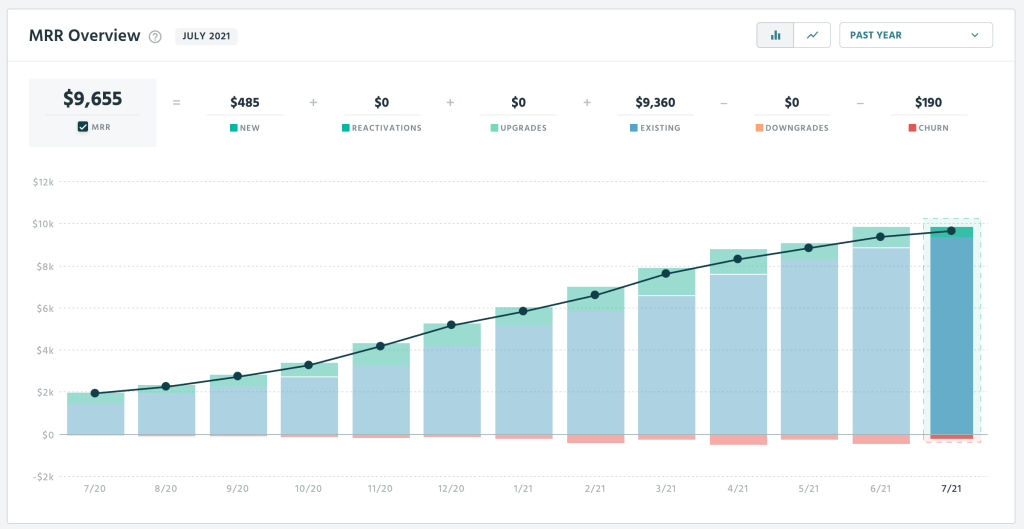
Overall, I made a $6k loss in the business last year.

Revenue: $172k

Expenses: $191k (mostly subcontractors)

Non operating revenue: $12k (investment gains)

House update

We’re looking at buying a place to live in Melbourne. Quite captivated by the idea of getting a townhouse in Port Melbourne but I suspect that’s outside our budget (~$800k). Another option is to find a place by the beach quite far away from the city. Budget wise that would be great: we’d be able to get a place with a large block for $800k. I think I’d be very happy living in a small town and my wife is open to it but there is some difficulty about where her parents would live as they’re going to be moving to Australia soon (from China) and want to live close to us. I think they’d prefer to live somewhere like Springvale where there is a large Chinese speaking community. Many discussions to be had.

I’m pretty clueless when it comes to property so am listening to some podcasts and will probably do a course + engage a buyer’s advocate to help. Our timeframe is to make a purchase early next year.

Europe trip

Still keen to do a 12 month stint in Europe. Might do it at the start of 2023.

FI Goals

My (fat) FI number is $1.625M. 20% of the way there.

My coasting calculations indicate I’ll get there in 2042 assuming that I can get my business profit to $50k next year and keep it at that level until 2042 (I’d be 54). My wife will probably get there well before I do (2035).

April 3rd 2021 Portfolio update

Crazy quarter of investment gains. Somehow up $141k in 3 months (mostly from crypto).

Asset ClassDec 31 2020April 3rd 2021ChangeNotes
Business cash$15k$22.8k+$7kNo real change – just had a few payments come in recently
Business investments$23.9k$20.6k-$3.3kHave sold off some of my shares as I was having cashflow issues in my business
Personal cash reserve$7.5k$17k+9.5kSold a bit of crypto and keeping it in cash for now
Cryptoassets$33.8k$150k+$116.2kCrazy gains. I sold off $12k but it’s still going up
Property (brickX)$9k$10.2k+$1.2kMinimal growth
Precious metals$18.96k$18.5k-$0.46Weirdly this is going down despite all the money printing going on
Shares$76.22k$75.7k-$500Haven’t put any more cash in
Green bonds$12k$12k0No change
Super$118k$125k+$7kOnly compulsory contributions now
HELP debt-$12k-$11k+$1k
Net worth$303k$444k+$141k

Expenses

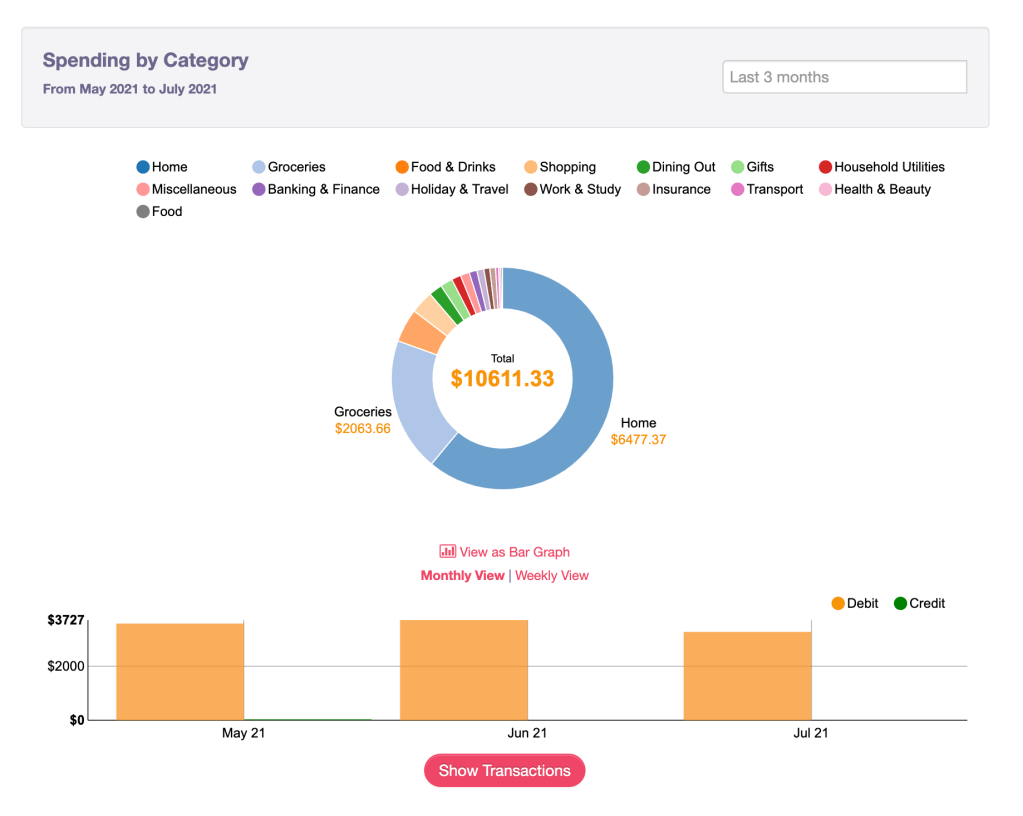
Expensive quarter with some back taxes, dental expenses (special anti teeth grinding night guard) and moving house (moving back to Melbourne).

Life update

My wife landed a job in Melbourne so we’ve been packing up and getting rid of as much stuff as possible. We’ll move in mid April.

Career update

Still in the same situation as in my last update: working 3 days per week in my solar job (which I’m enjoying) and 1 day per week for my old job. Finding it a bit hard to balance part time work with part time work in my business.

Business update

Cashflow has been tight in my business. Revenue is similar to before ($10k AUD/month) but my expenses have been quite high so I was actually running at a loss for most of the quarter. Cash position improved a bit in the last two weeks thanks to some pre-sales and selling off some of my shares. Am hoping I’ll reach break-even next quarter.

Training update

The move to Melb has disrupted my training plans a bit. I’ll have to find a new TAFE in Melbourne.

Europe trip

Still keen to do a 12 month stint in Europe. Might do it at the start of 2023.

FI Goals

My new (fat) FI number is $1.625M. A quarter of the way there.

Dec 31st 2020 portfolio update

Pretty big year for investment growth. I somehow finished the year up $104k which is bonkers considering the economic situation. Most of that was from investment gains. I only put in roughly $45k of my own cash.

Asset ClassJan 1 2020Dec 31 2020ChangeNotes
Business cash$24.2k$15k-$9kReinvesting in business
Business investments$13.7k$23.9k+10kI didn’t put any more cash in, it’s just been growing mainly thanks to TSLA and a few other similar stocks
Personal cash reserve$9k$7.5k-$1.5k
Cryptoassets$11k$33.8k+$22kI put in an additional $2k in cash, the rest is from the big bull run recently
Property (brickX)$6.7k$9k+$2.2kMinimal growth
Precious metals$17.3k$18.96k+$1.5kThis was up much higher at the peak of the market collapse – nice to have a hedge
Shares$41.9k$76.22k+$35kI put in ~$20k. Portfolio grew by 32%
Green bonds$12k$12k0No change
Super$79k$118k+$39k$20k came from cash contributions, $18k from fund growth
HELP debt-$19k-$12k+$7k
Net worth$195k$303k+$104k

Expenses

I don’t have a breakdown but it was $16k in total for the year. A bit lower than previous updates because there weren’t many opportunities for travel and I stopped a few hobbies (martial arts) + cancelled my hospital insurance (extras only now).

Career update

I’ve nearly finished moving over to my new job. From Jan 2021 I’ll be working 3 days a week in the dream job (writing software for solar microgrids in isolated communities in developing countries). That will hopefully increase to 4 days per week throughout the year as I detach from the old job completely (still doing 1 day per week at the moment).

Business update

My business has been going well. In December, my revenue from software sales was close to $10k AUD/month. Profit is still minimal because I’m reinvesting the majority of the revenue (building a mobile app, hired a customer support person). I’m hoping midway through this year, revenue will have grown to $15k AUD/month and I’ll be making a decent amount of profit there.

Training update

This is my final year in my Cert III in Carpentry. Should be fun – we’ll be doing advanced roofing. I’m hoping to leverage these skills to build our own place in 2023.

Goal for the year ahead: prepare for a Europe trip in 2022/kids in 2023

My wife and I have been looking ahead and have decided that 2023 would be a good time to settle down and have kids. Before we do that, we’re keen to scratch the travel itch and spend a decent amount of time in Europe. We’re looking at spending 6-12 months there in 2022 (depending on COVID restrictions). I’ll be focusing on building up cash for that trip.

FI goals

I’ve altered my FI goals from my previous aim to “retire” after reaching Lean FI with an asset pool of $625k. I’ve realised that I would like to do a fair bit of international travel (mainly to the snow fields) and therefore an annual income of $75k (before tax) is closer to my needs. This will take much longer to reach – some time in my late 40s if I consistently earn more than I spend or in my early 60s if I coast from here on and only earn just enough to meet my expenses. Either way, it’s nice to know that I’ve basically done the hard work now and compounding will take care of the rest. I’d like to slow down and enjoy life a bit more.

Portfolio update August 2020

Quick update on my progress since July 2019. My hard asset net worth is now up to $260k (from $175k). I’ve shifted my investment approach based on the model portfolios on https://www.sustainableeconomist.com/

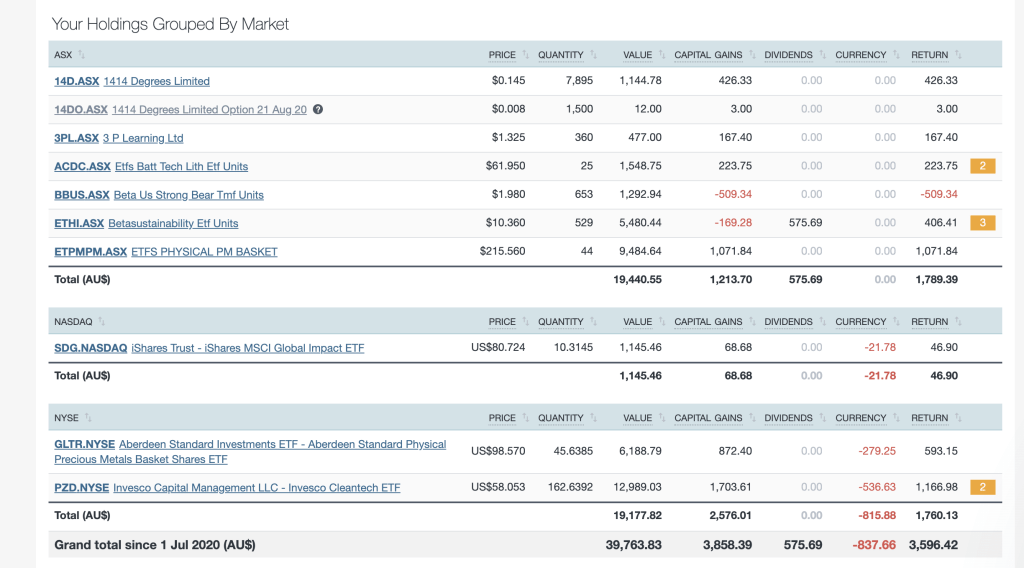
I’m now putting all my equity investments into SDG (iShares global impact ETF) My portfolio has done well through the COVID dip, mirroring results more broadly for ESG indexes which have tended to outperform the S&P 500.

My precious metal holdings have also helped:

Overall portfolio update:

Hard Assets (not including startup equity/business equity):

  • $105k in superannuation (retirement fund accessible at age 65) invested with Australian Ethical (though I’ll probably change that due to their high fees)
  • $62.8k in ETFs (ETHI.ASX, PZD.AMEX, ACDC.ASX, ETPMPM.ASX), Raiz and individual shares.
  • $17k in cryptocurrency (mostly HOT and BTC – other crypto “assets” have not performed well)
  • $5k in cash in personal bank accounts
  • $21k in precious metals (buffer against market crashes)
  • $13k in US ETFs (PZD.AMEX, ACES.AMEX, GLTR.AMEX, ICLN.AMEX, LIT.AMEX, BLCN.AMEX) and individual stocks (TSLA.AMEX, ABB.AMEX, BYND.AMEX) owned by my business
  • $25k in cash in business bank accounts
  • $4.5k in “property” via Brickx.com.au

Liabilities:

  • $16k in HELP debt (student loan from Australian government with 2% interest rate)

Update on my expenses

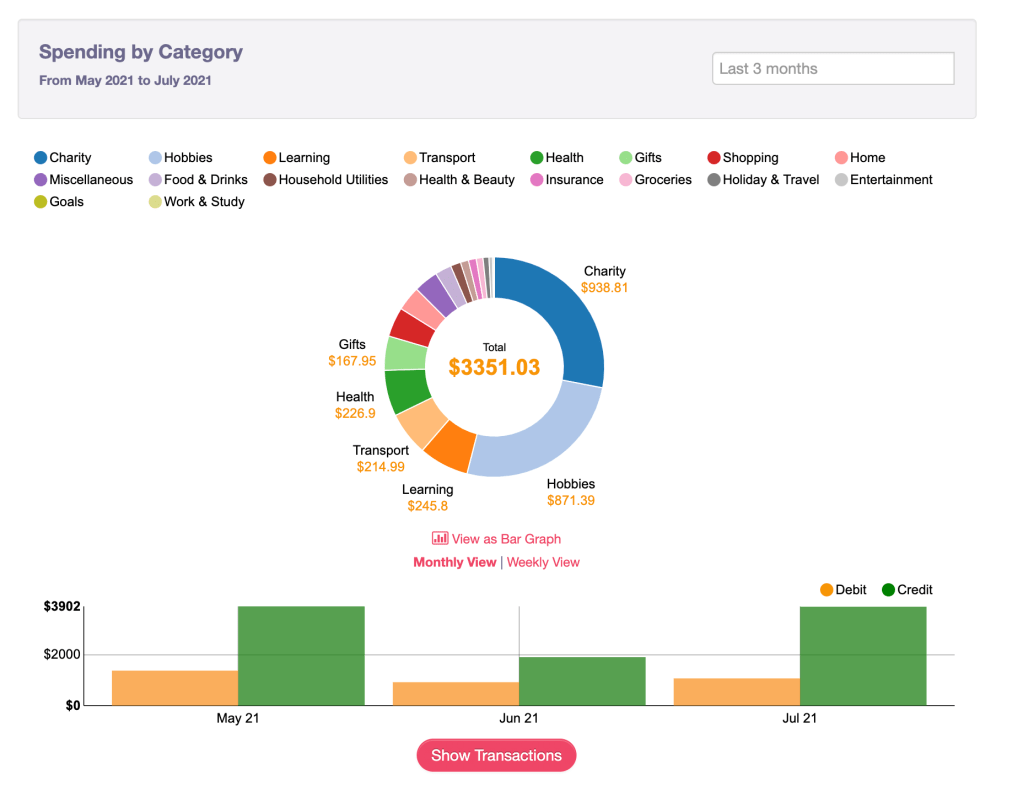
I’ve reduced my expenses somewhat. I’m now spending ~$18k AUD/year

  • $0/year in rent (my wife owns the apartment we live in. If I were single, I’d spend ~$10k/year on rent)
  • $4k/year in charitable donations after tax ($6k before tax)
  • $2.5k/year on food
  • $3k/year for skiing (I love cross country skiing)
  • $1.5k/year for private health insurance
  • $1250/year on holidays
  • $1000/year for other medical expenses (physiotherapy, allergy treatment)
  • $850/year on public transport
  • $850/year on bills
  • $800/year on books and non tax-deductible educational expenses
  • $600/year on gifts
  • $300/year on bicycle maintenance
  • $200/year on other hobbies
  • $175/year on contents insurance
  • $75/year on eating out
  • $200/year in other misc expenses

Update on my income

I am now working two part time jobs as well as running my business

  • day job 1 (2 days per week): $48k/year before tax
  • day job 2 (1 day per week): ~$20k/year before tax
  • business: ~$40k/year profit before tax

My business profit has increased a bit in the last 12 months and is heading in a positive direction. I’ve launched two new SaaS products since July 2019 and these are generating $1600/month in revenue.

Decision log on going down to 2 days per week in my main job

The situation or context

I’m currently working 3 jobs:

  • day job 1: 3 days per week, bringing in $72k/year before tax ($43.7k net after voluntary super contributions plus tax).
  • day job 2: 1 day per week, being paid in equity
  • side business: ~2 days per week (evenings and weekends), bringing in $35k/year

Plus doing one day per week of carpentry study at TAFE.

My living expenses are $15k. Therefore I have abundant free cashflow at the moment but a marked lack of free time.

I am fitting in work in my business around the edges and often find myself frazzled, stressed and feeling out of integrity when I do business tasks during my day job hours.

My business is growing relatively rapidly particularly with the launch of a new product which has already eclipsed the revenue from all my other products within 3 months:

With more customers, I am finding myself doing a lot of customer support and ad hoc development but don’t really have the time for it.

I also have another product I am meant to be building for the RTO sector but haven’t had the time to devote to it.

One of my goals is to be work optional – to only take on PAYG/consulting work if I really love the company. To get to that point, I need a few things:

  1. $375k in diversified index funds (currently at $80k)
  2. >= $15k/year in product revenue (achieved. Currently at ~$35k AUD/year)
  3. >= $15k in liquid investments (cash and other current assets) to tide me through a period of unemployment. Achieved

The problem statement or frame or primary thesis

I don’t have sufficient time available to build these products (or to enjoy life). 

How are your values currently being violated?

  • Integrity: 
    • Having to catch up hours for day job on weekend because I’m getting distracted by the business during the week
    • Delivering work behind schedule for clients 
    • I’ve ghosted a few volunteer commitments because I’ve been too busy
    • Not making enough time to spend with my wife on weekends

The variables that govern the situation

  • My expenses (are they likely to increase rapidly in the short term? Probably not)
  • Relationship with my employer (would going down to 2 days damage the relationship? Probably not because I already told them I was resigning at the start of the year so they know I’m on my way out)
  • My other commitments (if I take on new commitments thinking I now have all this free time, I’ll find myself in the same hole I’m in now. I need to be very firm about not committing to anything beyond what I have already committed to)

Is this a high impact, non reversible decision? If not, does it require so much deliberation (note down your rationale here)?

It’s completely reversible. I’ll be starting a new job sometime in 2021 and will probably go back to 4 days per week then. My current job is very flexible and I don’t think they’d mind.

Recognise what you don’t know (as much as what you do)

  • How productive will I be with an extra day? Will I squander it?

Do you have an advisor who has experienced these unknowns before that can clarify for you?

I’ve been listening to Startups For The Rest Of Us. They suggest the stairstep model which is basically what I’m proposing. 

The complications or complexity as you see it

  • How will I ensure that my employer isn’t adversely affected by this change? I have team members who rely on my input and I wouldn’t want them to be blocked on the days I’m not working. I may need to budget 30 mins to answering Slack messages.

Alternatives that were seriously considered and why they were not chosen (think: the work required to have an opinion)

  • Shut down the business: possible but seems undesirable when it’s showing promise
  • Quit the job completely: possible but I actually like most aspects of the job and don’t want to work on these products full time

Is it possible to trial out your decision? E.g. if you’re considering painting, can you take a week of leave and paint and see how it is?

Yes I’ve asked for two days of leave spread out over the next two weeks and then I have a holiday from TAFE which will mean I’ll have an extra day per week for the next month. This is similar to the amount of extra time I’d have.

Are you leaning?

Yes I want to go down to 2 days.

If you flipped a coin or asked an oracle, what are you hoping they answer?

Do it!

What unique advantages or insights do I have in this situation?

  • Flexible employer who wants to keep me on
  • Knowledge of the products I’m building

Who is the best person to make this decision? What unique advantages do they have?

Me.

Have you talked through your process with someone (even a rubber duck)?

With my wife. She has no objections.

A paragraph explaining the range of outcomes

  • Product might completely fall flat and all the customers I have now might disappear
  • Product might grow 10x and then I’d have to decide if I want to do it full time
  • Product might grow geometrically

What second and third-order consequences have you considered?

  • Impact on other people in my team: I think it would actually be good as it would free up budget to hire a junior developer part time.
  • Impact on my mental health: likely positive
  • Impact on my relationships: likely positive as I’d have more time and emotional energy

What is the worst-case scenario? Is it acceptable?

  • Employer gets outraged I’d propose this and fires me. I can handle it as I have sufficient income from the business + savings to keep me going plus another job.

What is the opportunity cost? By doing this what am I not doing?

  • Working at a job I don’t find super stimulating

What is the potential upside beyond the core thesis?

  • Helps me to simulate what it would be like to have abundant free time

A paragraph explaining what you expect to happen and the reasoning and probabilities you assign to each projected outcome (The degree of confidence matters, a lot.)

  • Employer is fine with it: 90% probability
  • Product grows geometrically: 80% probability
  • Mental health improves: 70% probability
  • Relationship with wife and colleagues improves: 80% probability

How might you feel 10 minutes, 10 months or 10 years from now? (can apply in reverse, how might you feel if you had made the decision 10 minutes, months or years from now?)

  • 10 minutes: slightly anxious about how boss will react
  • 10 months: probably glad
  • 10 years from now: glad I prioritised quality of life

After you make this decision, what will the next question likely be? Will you be able to answer this question?

  • What do I do about the other commitments I don’t want to do (e.g. SES, Toastmasters Area Director)? I probably need to write separately about this

The time of day you’re making the decision and how you feel physically and mentally (If you’re tired, for example, write it down, write down any emotions)

I’ve been thinking about this for the last 24 hours and my certainty around the decision has strengthened the longer I’ve spent thinking about it.

Set a review date
In 2 weeks time – I’ll make a call then whether to talk to my boss

About Ethical FI

The FIRE (financial independence retire early) movement is picking up momentum. There is now a lot of information available about reducing expenses and investing in index funds. However, I don’t resonate with some of the bloggers who seem to be focused on achieving FIRE at any cost. 
Here are some of the problems I see with some approaches to FIRE:

  • Investing in broad market indexes without scrutinising their holdings: many of the top holdings of these ETFs are fossil fuel companies or companies with questionable labour practices. Whilst there is an argument that as a shareholder, you are simply following market trends, this ignores the role that ETF companies like Vanguard/Black Rock have in voting on shareholder resolutions (hint: they often don’t vote for resolutions that promote environmental sustainability, good governance or fair labour practices. See Green Governance for details). 
  • Real estate investment at the expense of the community: real estate can be ethical if it involves building new houses or renovating existing houses to open up new housing supply but not if it involves jacking up rents while minimising expenditure on maintenance so that tenants end up spending so much on energy bills that they can never save enough to buy their own home.
  • Working for the enemy: some FIRE advocates choose to work for morally reprehensible organisations to boost their salaries and savings rates, telling themselves that when they retire, they will volunteer lots of time to charity. This ethical calculus doesn’t stack up for me. You would spend most of the rest of your life undoing the harm that you did during your working life.
  • Avoiding charity donations: in an effort to improve their savings rates, many FIRE advocates choose to give nothing to charity. I think this is short sighted. Just as investments compound over time, so too can charitable contributions. Donating to (effective) charities allows people to pull themselves out of poverty and contribute back to society. I’m quite happy to push back my FIRE date by a year or two if it means that when I do reach FIRE, other people are doing better off as well.

My view is that there is a road to FIRE that improves social and environmental outcomes without compromising financial returns. I’ve started this blog to share my research into ethical investment vehicles, environmentally friendly frugality hacks, jobs that pay well without causing harm and effective altruism.


My background

I studied environmental science at uni and am focused on doing what I can to prevent dangerous climate change. I work as a software developer at an energy efficiency company which plays a small but significant part in cutting CO2-e emissions.

I have been following the FIRE movement since 2015. I am currently 31 years old and have a “hard asset” (not including startup equity/business equity) net worth of $174k. That’s broken up as follows:

Assets:

  • $75k in superannuation (retirement fund accessible at age 65) invested with Australian Ethical (though I’ll probably change that due to their high fees)
  • $27k in ETFs (ETHI.ASX, PZD.AMEX, ACDC.ASX, ETPMPM.ASX), Raiz and individual shares.
  • $19k in cryptocurrency (mostly HOT and BTC – other crypto “assets” have not performed well)
  • $15k in cash in personal bank accounts
  • $14.5k in precious metals (buffer against market crashes)
  • $11.3k in US ETFs (PZD.AMEX, ACES.AMEX, GLTR.AMEX, ICLN.AMEX, LIT.AMEX, BLCN.AMEX) and individual stocks (TSLA.AMEX, ABB.AMEX, BYND.AMEX) owned by my business
  • $8k in cash in business bank accounts
  • $4.5k in “property” via Brickx.com.au

Liabilities:

  • $21.3k in HELP debt (student loan from Australian government with 2% interest rate)

My take on ethics

I see the following industries as unethical and do not want to profit from them:

  • Gambling
  • Fossil fuel extraction/processing
  • Loansharks/payday lending
  • Factory farming
  • Fast food companies
  • Organisations that discriminate based on race, gender, sexual orientation, disability or any other factor
  • Military contractors
  • Prisons
  • Organisations that are against LGBTQI/same sex marriage/transgender people/abortion

On the flip side, I believe that the following industries will flourish and want to put my money where my mouth is:

  • Solar/wind power
  • Energy storage
  • Electric vehicles
  • Lab meat
  • Energy efficiency
  • Education
  • Recycling
  • Organisations that adhere to B Corp levels of transparency and social impact measurement

My FIRE history

My portfolio isn’t exactly where I want it to be. I took a few business gambles in my early 20s which resulted in a very low income ($25k AUD per year) for the first three years after graduating from university as well as incurring a reasonable amount of credit card debt ($20k). In 2015, I pulled the plug on full time entrepreneurship and got a day job. This allowed me to pay off the debt and start investing. I’ve been fortunate to get a few promotions along the way and have also managed to make one of the businesses I started profitable. Currently I’m earning $96k/year from my day job as a software developer (working four days per week) and ~$15k/year from the business.

My FIRE goals

My primary goal is to hit $180k in superannuation. If I can get there, I have reached coasting FI. Even if I had no investments outside super, I’d just need to earn enough to pay for my expenses and let the money in super compound for the remaining years until I can access it. At my current run rate, I should be able to reach this figure within 3 years.


The secondary goal is to reach a net worth of $500k. My expenses are ~$19k per year so based on the 4% rule, $500k would be enough for me to longer need to work. I intend to continue growing my business so that it can provide an additional source of income for charitable donations and any lifestyle inflation that might emerge (my partner and I are considering having kids).


My expenses

The $19k/year is broken down as follows:

  • $0/year in rent (my wife owns the apartment we live in. If I were single, I’d spend ~$10k/year on rent)
  • $4k/year in charitable donations after tax ($6k before tax)
  • $2.5k/year on food
  • $3k/year for skiing (I love cross country skiing)
  • $1.8k/year for krav maga self defence training (quite a lot but it’s a skill I want to develop and pretty hard to train on your own!) 
  • $1.5k/year for private health insurance
  • $1250/year on holidays
  • $1000/year for other medical expenses (physiotherapy, allergy treatment)
  • $850/year on public transport
  • $850/year on bills
  • $800/year on books and non tax-deductible educational expenses
  • $600/year on gifts
  • $300/year on bicycle maintenance
  • $200/year on other hobbies
  • $175/year on contents insurance
  • $75/year on eating out
  • $200/year in other misc expenses

My FIRE plan

Given that my primary goal is to reach $180k in super, I will put $25k per year into super ($9k in compulsory super and $16k in voluntary contributions: the maximum threshold before you lose tax benefits). I’ve been doing this for the last 3 years and find it works well: my employer directly pays it into my super fund so I never notice the cashflow hit. I end up saving close to $8k in tax through this strategy (voluntary super contributions are only taxed at 15% vs my normal marginal tax rate of 37%). 

After voluntary super contributions, I am left with $57k per year after tax and therefore $37k to invest after paying my living expenses. As well as this, my business (set up as a company for tax and liability purposes) currently generates $15k/year in after tax profits. I can therefore invest $50k/year after tax.

Assuming modest growth from my existing investments, that means I should be able to reach $500k within 4 years. Of course there may well be a recession during that time (signs are certainly pointing that way), so I’m not expecting to be able to fully stop working for another 8 years.

In terms of how I’ll invest the $50k/year after tax, I plan to:

  • Put $35k into ethical ETFs like ETHI, PZD and CLN (blog post to follow discussing which ethical ETFs are best)
  • Put $15k into precious metals

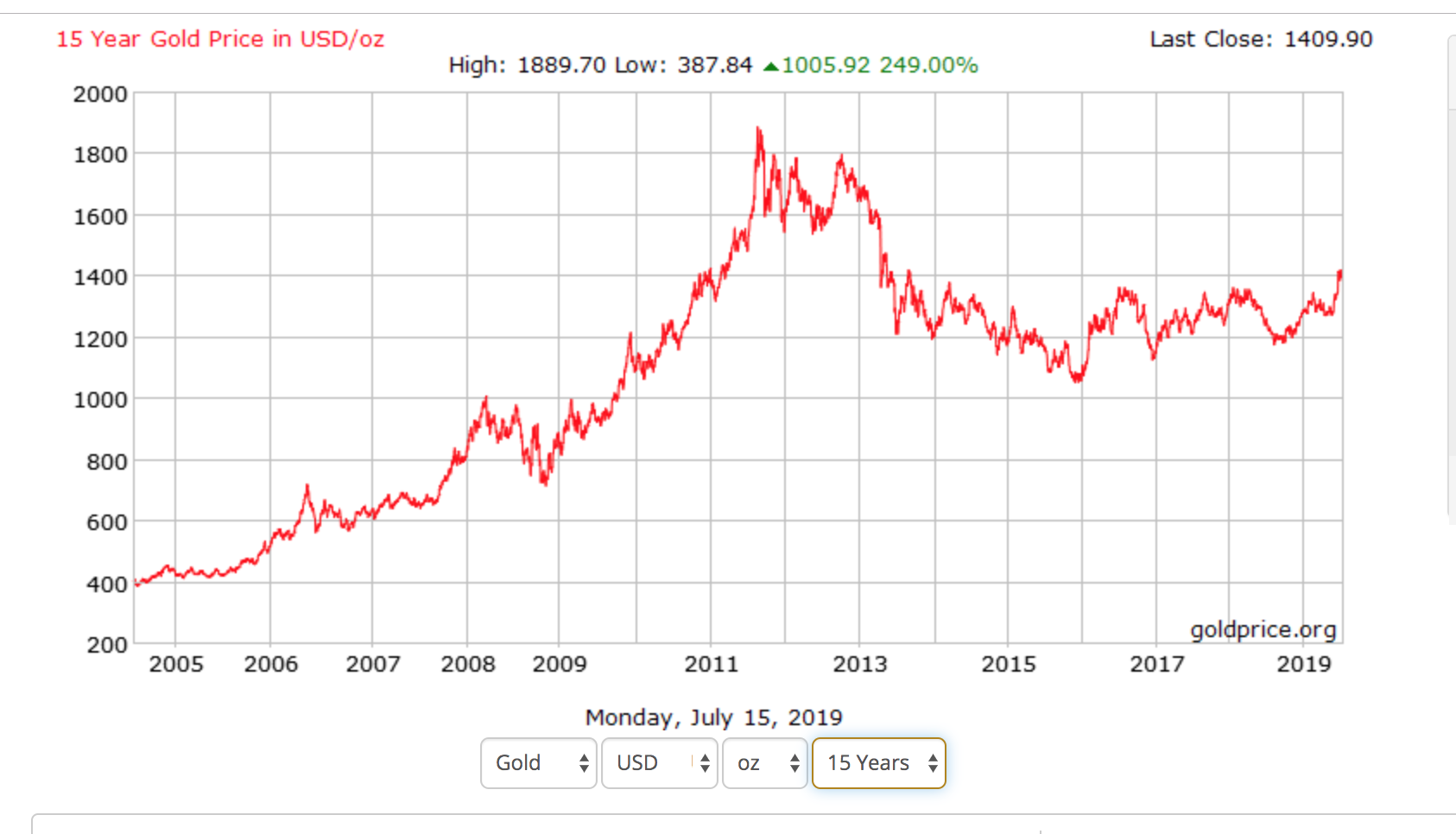
The second part probably sounds surprising. I’m following that approach because I have a strong suspicion that there will be a deep recession matching the Global Financial Crisis in severity within the next four years. In the long run, the sharemarket always goes up but every ten years or so, there’s generally a decent sized correction. Looking at commodity prices during the GFC, gold nearly tripled from 2008 to 2011.

My plan is to cash out my precious metal holdings (primarily owned via commodity ETFs) when a recession hits and use the cash to buy property.

Design a site like this with WordPress.com
Get started