The FIRE (financial independence retire early) movement is picking up momentum. There is now a lot of information available about reducing expenses and investing in index funds. However, I don’t resonate with some of the bloggers who seem to be focused on achieving FIRE at any cost.
Here are some of the problems I see with some approaches to FIRE:
- Investing in broad market indexes without scrutinising their holdings: many of the top holdings of these ETFs are fossil fuel companies or companies with questionable labour practices. Whilst there is an argument that as a shareholder, you are simply following market trends, this ignores the role that ETF companies like Vanguard/Black Rock have in voting on shareholder resolutions (hint: they often don’t vote for resolutions that promote environmental sustainability, good governance or fair labour practices. See Green Governance for details).
- Real estate investment at the expense of the community: real estate can be ethical if it involves building new houses or renovating existing houses to open up new housing supply but not if it involves jacking up rents while minimising expenditure on maintenance so that tenants end up spending so much on energy bills that they can never save enough to buy their own home.
- Working for the enemy: some FIRE advocates choose to work for morally reprehensible organisations to boost their salaries and savings rates, telling themselves that when they retire, they will volunteer lots of time to charity. This ethical calculus doesn’t stack up for me. You would spend most of the rest of your life undoing the harm that you did during your working life.
- Avoiding charity donations: in an effort to improve their savings rates, many FIRE advocates choose to give nothing to charity. I think this is short sighted. Just as investments compound over time, so too can charitable contributions. Donating to (effective) charities allows people to pull themselves out of poverty and contribute back to society. I’m quite happy to push back my FIRE date by a year or two if it means that when I do reach FIRE, other people are doing better off as well.
My view is that there is a road to FIRE that improves social and environmental outcomes without compromising financial returns. I’ve started this blog to share my research into ethical investment vehicles, environmentally friendly frugality hacks, jobs that pay well without causing harm and effective altruism.
My background
I studied environmental science at uni and am focused on doing what I can to prevent dangerous climate change. I work as a software developer at an energy efficiency company which plays a small but significant part in cutting CO2-e emissions.
I have been following the FIRE movement since 2015. I am currently 31 years old and have a “hard asset” (not including startup equity/business equity) net worth of $174k. That’s broken up as follows:
Assets:
- $75k in superannuation (retirement fund accessible at age 65) invested with Australian Ethical (though I’ll probably change that due to their high fees)
- $27k in ETFs (ETHI.ASX, PZD.AMEX, ACDC.ASX, ETPMPM.ASX), Raiz and individual shares.
- $19k in cryptocurrency (mostly HOT and BTC – other crypto “assets” have not performed well)
- $15k in cash in personal bank accounts
- $14.5k in precious metals (buffer against market crashes)
- $11.3k in US ETFs (PZD.AMEX, ACES.AMEX, GLTR.AMEX, ICLN.AMEX, LIT.AMEX, BLCN.AMEX) and individual stocks (TSLA.AMEX, ABB.AMEX, BYND.AMEX) owned by my business
- $8k in cash in business bank accounts
- $4.5k in “property” via Brickx.com.au
Liabilities:
- $21.3k in HELP debt (student loan from Australian government with 2% interest rate)
My take on ethics
I see the following industries as unethical and do not want to profit from them:
- Gambling
- Fossil fuel extraction/processing
- Loansharks/payday lending
- Factory farming
- Fast food companies
- Organisations that discriminate based on race, gender, sexual orientation, disability or any other factor
- Military contractors
- Prisons
- Organisations that are against LGBTQI/same sex marriage/transgender people/abortion
On the flip side, I believe that the following industries will flourish and want to put my money where my mouth is:
- Solar/wind power
- Energy storage
- Electric vehicles
- Lab meat
- Energy efficiency
- Education
- Recycling
- Organisations that adhere to B Corp levels of transparency and social impact measurement
My FIRE history
My portfolio isn’t exactly where I want it to be. I took a few business gambles in my early 20s which resulted in a very low income ($25k AUD per year) for the first three years after graduating from university as well as incurring a reasonable amount of credit card debt ($20k). In 2015, I pulled the plug on full time entrepreneurship and got a day job. This allowed me to pay off the debt and start investing. I’ve been fortunate to get a few promotions along the way and have also managed to make one of the businesses I started profitable. Currently I’m earning $96k/year from my day job as a software developer (working four days per week) and ~$15k/year from the business.
My FIRE goals
My primary goal is to hit $180k in superannuation. If I can get there, I have reached coasting FI. Even if I had no investments outside super, I’d just need to earn enough to pay for my expenses and let the money in super compound for the remaining years until I can access it. At my current run rate, I should be able to reach this figure within 3 years.
The secondary goal is to reach a net worth of $500k. My expenses are ~$19k per year so based on the 4% rule, $500k would be enough for me to longer need to work. I intend to continue growing my business so that it can provide an additional source of income for charitable donations and any lifestyle inflation that might emerge (my partner and I are considering having kids).
My expenses
The $19k/year is broken down as follows:
- $0/year in rent (my wife owns the apartment we live in. If I were single, I’d spend ~$10k/year on rent)
- $4k/year in charitable donations after tax ($6k before tax)
- $2.5k/year on food
- $3k/year for skiing (I love cross country skiing)
- $1.8k/year for krav maga self defence training (quite a lot but it’s a skill I want to develop and pretty hard to train on your own!)
- $1.5k/year for private health insurance
- $1250/year on holidays
- $1000/year for other medical expenses (physiotherapy, allergy treatment)
- $850/year on public transport
- $850/year on bills
- $800/year on books and non tax-deductible educational expenses
- $600/year on gifts
- $300/year on bicycle maintenance
- $200/year on other hobbies
- $175/year on contents insurance
- $75/year on eating out
- $200/year in other misc expenses
My FIRE plan
Given that my primary goal is to reach $180k in super, I will put $25k per year into super ($9k in compulsory super and $16k in voluntary contributions: the maximum threshold before you lose tax benefits). I’ve been doing this for the last 3 years and find it works well: my employer directly pays it into my super fund so I never notice the cashflow hit. I end up saving close to $8k in tax through this strategy (voluntary super contributions are only taxed at 15% vs my normal marginal tax rate of 37%).
After voluntary super contributions, I am left with $57k per year after tax and therefore $37k to invest after paying my living expenses. As well as this, my business (set up as a company for tax and liability purposes) currently generates $15k/year in after tax profits. I can therefore invest $50k/year after tax.
Assuming modest growth from my existing investments, that means I should be able to reach $500k within 4 years. Of course there may well be a recession during that time (signs are certainly pointing that way), so I’m not expecting to be able to fully stop working for another 8 years.
In terms of how I’ll invest the $50k/year after tax, I plan to:
- Put $35k into ethical ETFs like ETHI, PZD and CLN (blog post to follow discussing which ethical ETFs are best)
- Put $15k into precious metals
The second part probably sounds surprising. I’m following that approach because I have a strong suspicion that there will be a deep recession matching the Global Financial Crisis in severity within the next four years. In the long run, the sharemarket always goes up but every ten years or so, there’s generally a decent sized correction. Looking at commodity prices during the GFC, gold nearly tripled from 2008 to 2011.
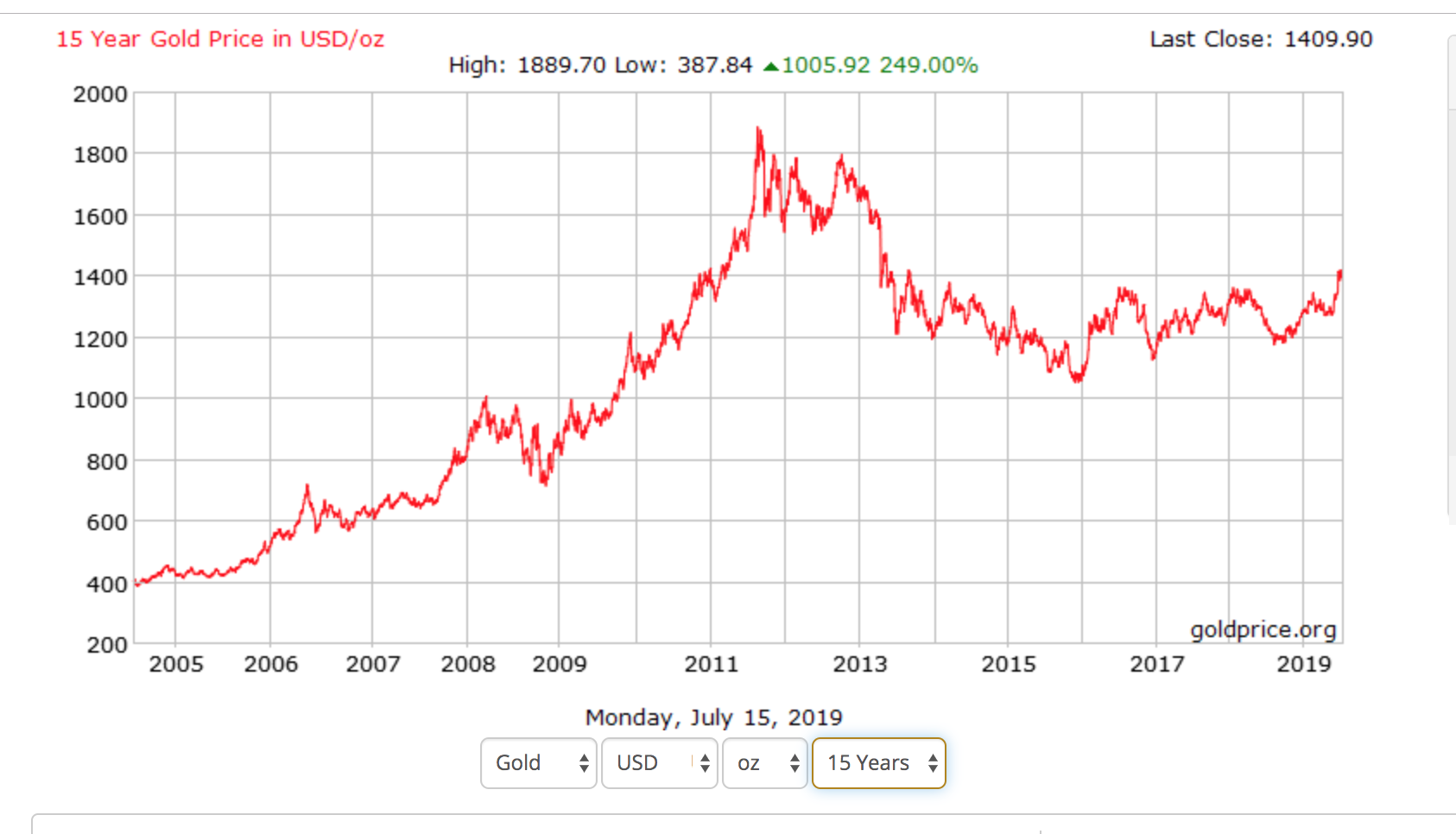
My plan is to cash out my precious metal holdings (primarily owned via commodity ETFs) when a recession hits and use the cash to buy property.
 Ethical Financial Independence